Photo Stroll – Jane Hilton’s Precious launched as a book and on show at Eleven Gallery London

JH4JH6

Phewwww. There has been a lot happening and finding the time to write blog posts has been difficult recently. Not least as I got a new six-month part-time contract as Editorial Content Manager and Project Developer for Frame and Reference  – an online visual arts magazine and resource for the South East, not including London. Please check the site out, sign up to the E-bulletin and twitter feed and give me feedback as I develop the site to make it a go-to resource for anyone interested in what’s happening in the visual arts. Plus, Hotshoe has been relaunched and the website redeveloped. This means there will be changes afoot with regards to this blog also as I want to maintain editorial control, develop some of the content further and keep the personal feel that I have tried to build over the last three years. More of this another day. For now, I want to share with you some photos taken at the opening of photographer and filmmaker Jane Hilton’s new show, Precious, a collection of nude portraits of Nevada working girls. The title is apt and describes Hilton’s feelings towards her subjects: “To me, they are all precious,” she says.

In 2010, Jane decided to return to the American West for her latest book, Precious, a collection of intimate nude portraits of working girls. Hilton visited eleven brothels to find women prepared to be photographed in the nude. She first came across Madam Kitty’s Cathouse (Nevada, USA) in 1998 and returned in 2000 to film ten documentary films here as well as at the Moonlite Bunnyranch (Nevada, USA). The women in the photographs work in brothels where she had already built strong connections as well as smaller places, such as Shady Lady’s and Angel’s Ladies. Using a plate camera, with its associated slowess, became a bonding experience for Hilton as she discovered how some of the women had “issues about their own body shape” and unraveled different feelings about their journey as a working girl. “In some cases this became a very positive and cathartic experience,” Hilton notes.

“I hadn’t even thought about prostitution until I walked into a brothel. I was probably very naive, which actually in retrospect did me a favour. I am by nature very non-judgemental, and feel it very important to have experience of a subject matter before making any points of view about it. For the last fifteen years I have spent a lot of time getting to know the working girls from the legal houses in Nevada, producing ten documentary films and an exhibition. I know there are some incredible women hidden in these brothels and I wanted to show this. So I decided to go back again to make a series of intimate portraits in eleven different brothels across Nevada.” Jane Hilton.

Unlike many other photographic bodies of work on prostitution where the women remain anonymous with no attempts made to find the humanity in their physicality, Precious names the women (first names only) and focuses on the women, their stories, their lives, their bodies and the places where they work. The worlds and the lived lives of these women are embedded in the portraits and animate the women, unlike (for me) other recent photographic projects on the subject.

For now, I’m thinking of how some projects and approaches (Joachim Schmid’s, LA Women; Mishka Henner’s, No Man’s Land, and Scott Southern’s, Lowlife can be seen to fuel anonymity and separate the women from the audience, the world in general and the photographer/visual artist. At times in these projects, the focus seems to be on the project idea, above all. Schmid publishes police released-photos from the collection of a serial killer of women, some of whom may or may not be prostitutes, while Henner takes a conceptual approach using Google images where the “street women” have pixelated faces – in both cases distance is reproduced again. I will pick up on this in more detail in a future post and add to the discussion the question of how easy, or difficult, it has been for Hilton to get the work seen because many of the portraits show women in the nude.

Prostitution is one of the oldest professions and, although it is legal in Nevada, it is still not socially acceptable. Precious, according to Hilton, aims to challenge “traditional ideas of beauty” through showing women from different cultural backgrounds, ages and body shapes, as well as to challenge “misconceptions” surrounding prostitution. Precious, however, draws the viewer in and reveals as much about the women’s lives as their bodies. In this series, the overriding impression is that Hilton really does care about her subjects; she has observed and listened to these women in ways that go beyond what they do to make a living.

The portraits are (as always with Hilton’s work) intimate and gentle portrayals of different women working as prostitutes in Nevada, as well as some landscape images and details from the brothels, which help provide a context for the portraits. The approach is sensitive and the aesthetic is familiar from Hilton’s previous work including her debut book, Dead Eagle Trail – Portraits of the American Cowboy. Look out for Chelsea, a former drug and sex addict who planned on a career in forensic science; Cassie, a bright and sunny optimist, who, as a young woman had to overcome the bleakest of pasts after witnessing her mother’s murder by a brutal stepfather, and who looks to a future where her ambition is to be a businesswoman and philanthropist. Then there’s Nikki, who, three months into her pregnancy, became a prostitute to save money for single motherhood; and Sonia, a married 52-year-old writer living in a brothel with her husband.

Precious is on show at Eleven Gallery, London and runs until 26 May. The hardback book is published by Schilt Publishing and is available for £35.

Photo Stroll – Liane Lang’s Fallen on show at Art First Projects London

LIANE LANG – FALLEN
I am interested in the idea of the sculptural object that has forfeited its role to be treated and seen as an artwork. Traditionally the sculpted figure loses its status as artwork the closer it becomes to being life‐like, ranging from the marble carving down to the tawdry side‐show reputation of the wax work. The Socialist statues, many made with great skill by important sculptors of the time, became culpable by association and lost their status as artwork in this way.

“Central to this series is the notion of iconoclasm, which continues into other projects. The statue becomes the object of bodily punishment in acts of iconoclasm, being treated as a symbolic site for physical humiliation, injury and execution in lieu of the real body. The symbolic act of deposition is often more powerful and long lasting than the fate of person portrayed.” Liane Lang

LianeLangLianeLang7

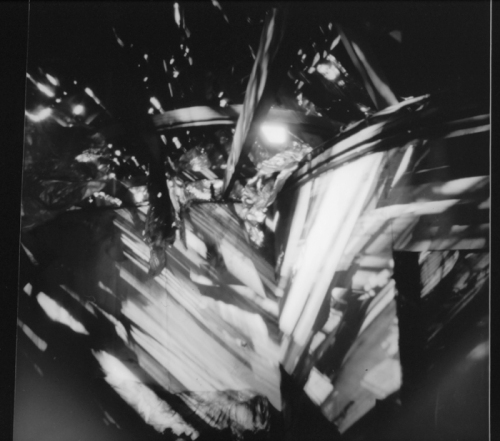
Winner of last year’s Hotshoe Photofusion Award, Liane Lang has a new solo show on until 11 May at Art First Projects London. I knew of Lang’s work from a previous post, way back when her series Monumental Misconceptions first came to my attention.

Needless to say, I went along to the private view last week to see Lang’s photographic and sculptural work and support her. I also grabbed a few shots for my Photo Stroll and was pleased to find out that she has also been selected for the Art Omi Residency 2013 in New York State this summer. If you are anywhere near the West End in London, do pop by and take a look. All the works are for sale; the photos are C-type prints in editions of 3 in two sizes and the cold-cast bronze statues are editions of 3 also. (ASIDE: The cold-cast bronze technique is one that is familiar; my mum worked for South African sculptor Giovanni Schoeman in Covent Garden in the 1970s and used to teach people how to cast them using the technique. Giovanni, however, met an untimely and rather gruesome end in a triple execution-style killing. Yes, this is true.)

Anyway, back to the show. Lang’s show Fallen “combines elements of her ongoing series of works undertaken during her residency at the Memento Sculpture Park in Budapest (the resting place of discarded and exiled monumental sculptural works from the socialist era in Hungary) with a new series of sculptures that take as their subject defaced and destroyed monuments to dictators and deposed leaders – the sculptures themselves derive from documentation of these acts of symbolic violence: from the black and white footage of the Czar’s statue being torn down by horse-power in Eisenstein’s 1928 film October, to contemporary footage of a different kind of horsepower at work on the iconic statue of Saddam Hussein in 2003.”
LianeLang5

“The role of scale in art is questioned in the show. “In the case of monumental sculpture, the sense of subjective appreciation or interpretation is determinedly overridden by the artist – the work has a distinct purpose and employs tried‐and‐tested mechanisms in its approach to materials and scale to achieve its function – to depict the subject as heroic; all‐powerful; permanent. By tweaking one of these vital mechanisms – scale – Lang is able to create space for a much broader range of interpretations.

“The statuesque subjects of her works are variously belittled (in their reduction to sculptural miniatures) or revealed as grotesques as Lang introduces her life‐size simulacra to them, highlighting the absurdity of their heroic poses. The resulting original works thus retain the echo of the appropriated sculptures polemic message, but create room around them for humour and a strange and haunting beauty, born of empathy – for the mighty (however tyrannical) brought low, and for the very human condition of impermanence.” Press release.
LianeLang9 LianeLang4 LianeLang3

This slideshow requires JavaScript.

All iPhone photos © Miranda Gavin 2013.

Outside Focus – Voices of the People: Ansel Adams’ landscapes on show at National Maritime Museum London

Today’s post is by third-year journalism student Kerrie Braithwaite, who is new to photography and has written her second review for Hotshoe Blog. Today she reviews the water-themed Ansel Adams exhibition currently on show at the National Maritime Museum in London.

Stream, Sea, Clouds, Rodeo Lagoon, Marin County, California, 1962 Photograph by Ansel Adams. Collection Center for Creative Photography, University of Arizona. © The Ansel Adams Publishing Rights Trust

“The works in this exhibition explore water in all its forms, from turbulent views of rapids and waterfalls to contemplative scenes of rivers and pools.”
Phillip Prodger, guest curator, Peabody Essex Museum

ANSEL ADAMS – PHOTOGRAPHY FROM THE MOUNTAINS TO THE SEA AT NATIONAL MARITIME MUSEUM
Ansel Adams‘ well-known large format images of American landscapes centred around water are presented in Photography from the Mountains to the Sea on show at the National Maritime Museum until 28 April.

Most of the photographs were printed by Adams himself and are accompanied by short passages to explain the photograph and its relation to water. However, looking at the large variety of images exhibited this is only one focus of his work. The exhibition shows how Adams photographed and played with the aesthetics of patterns and textures found within nature and from this created series of work. Adams’ mirroring technique made use of lakes and rivers and his sharply focused images connect the viewer intimately with nature. All of these focuses come together in a personal favourite, Maroon Bells, Near Aspen, Colorado, 1951.

The show begins with Adams’ early work, illustrating the influence of Pictorialism and his slow emergence from it, as well as the merging of Pictorialism and Modernism. The images are wistful and a reminder, for me, of how photography and painting once only tried to re-create what could be seen by the naked eye.

The Tetons and the Snake River, Grand Teton National Park, Wyoming, 1942, photograph by Ansel Adams. Collection Center for Creative Photography, University of Arizona. © The Ansel Adams Publishing Rights Trust

The display of the work is unusual and a variety of techniques are used. Some collections are sectioned off with low lighting; large screens show large formatted pictures and, towards the end, a documentary of the photographer’s life and career is screened in a medium-sized room with comfortable seating. Just when you think the exhibition is over, it leads on to another section, making it maze-like. The lighting is carefully directed at the images, giving the show a calm atmosphere.

Maps placed around the space show the locations where Adams took the photographs on show. Towards the end there is a small washing line with pegged-up notes hanging from it. The sign asks viewers to write down how this work has inspired them; some visitors drew pictures, some said it has inspired them “to travel through America”, to “go back to black and white photography” or “to go back to nature”.

Clearing Winter Storm, Yosemite National Park, California, about 1937 Photograph by Ansel Adams. Image courtesy of David H. Arrington

Clearing Winter Storm, Yosemite National Park, California, about 1937 Photograph by Ansel Adams. Image courtesy of David H. Arrington. Collection Center for Creative Photography, University of Arizona. © The Ansel Adams Publishing Rights Trust.

These photographs are more than detailed images of beautiful American scenery; they connect the photographer and the viewer to nature itself. Adam’s has revealed his spiritual journey by making these creations and connecting his viewers in the same way that he must have felt connected with nature and, for me, there is a sense of relief. Finally, there is a re-connection of humanity with nature as illustrated through photography.

Adams valued and loved the medium so much that he spent his life trying to convey this to a wider audience. However, there is also a sense of sorrow. Adams was a lonely boy with a close bond to his father, who supported his love of photography and it’s pleasant to witness in this exhibition what this boy grew up to become and what he created.

Photo Fun – Intimate Portraits Near and Far Over a Century

Barry Adamson

Barry Adamson, © photo by Barry Adamson

AnneGavin1960s

Anne Gavin and Miranda Gavin, photographer unknown. 1965

Olivebevis1910

Olive Bevis, photographer unknown, circa 1910.

It’s been one hell of a week. A Siberian Front hit Brighton and everything turned white and came to a stand still for a couple of days. Work got in the way of being able to post regularly and blog life took a back seat. Until today.

So, I thought I’d ease myself back into the blogosphere with some intimate monotone portraits spanning 1910 to 2013. It shouldn’t be hard to guess the years.

Thanks to Barry Adamson, who is currently on tour with Nick Cave and the Bad Seeds; to my lovely mum for allowing me to share this studio portrait of her with me (the gormless one); and to my maternal great grandmother, Olive Bevis, who I never met but who loved a good read.

Enjoy.

Photo News – Call for entries to Renaissance Photography Prize 2013 with an early bird discount till 15 March

During my recovery period, day-to-day concerns became irrelevant, and I became more aware of the moments that really matter in life – moments of emotion, human connection, and wonder at the beauty of nature. What better way to represent those moments than through photography?”
Fiona Gifford, a lawyer and keen amateur photographer who was diagnosed with breast cancer, aged 34, founded the competition in 2006.

008

RENAISSANCE PHOTOGRAPHY PRIZE 2013
The Renaissance Photography Prize is now open for online entries and there is an early bird discount of 20% if you submit your images by 15 March. It is an international photography award that showcases outstanding photography from emerging or established photographers while raising funds to support young women with breast cancer. All profit from entries is donated to The Lavender Trust at Breast Cancer Care, UK and there are a range of prizes.

I’ll be on the judging panel for the Series category and have been a keen supporter of the competition, since I met Fiona in 2008. I will be supporting the competition on the blog until the deadline by featuring the logo. I recently did a short interview with Renaissance for its February newsletter, see below for an excerpt from the interview. The full version should be on the website soon as I had rather a lot to say. For now, here’s a taster:

You will be volunteering to judge this year’s prize – What made you support Renaissance?
Honestly? My mother was diagnosed with advanced breast cancer in 2008 and I happened to meet Fiona [Gifford, the founder] the same year. We got talking and discovered a shared passion for photography. So many photo competitions charge entry fees that amount to a small fortune when you total them up and I often wonder where the money goes. With the Renaissance Photography Prize all the money goes to the Lavender Trust. 

What are you looking for when you judge a photography prize? 
I like to find images that resonate with me and give me a sense of the photographer, their vision and imagination. I am drawn to photos that evoke emotion… I see a lot of clichéd images that show me the same subjects, whether portraits or landscapes, portrayed in a generic fashion. With a series, it’s important that the photographs are cohesive and hang together as a whole. But that doesn’t mean that they all need to look the same – it’s about the overall sense of the series as well as about the individual shots. I think that one of the most challenging aspects in creating a series is producing a tight edit, one in which all the photos are working individually and together.

In the five years since its inception, Renaissance has raised over £200,000 for the charity. Entering gives photographers a chance to have their work judged by some of the top names in the industry and win prizes with a total value of over £5,000, including cash, photographic equipment, portfolio reviews and the winning series published in HotShoe Magazine. In addition, 60 selected photographs will form part of the Renaissance exhibition held this autumn in a prestigious London gallery.

Previous prize winners include Renaissance Photography Prize 2012 to Anastasia Taylor-Lind (United Kingdom), Calumet Film Prize 2012 to Julieta Sans (United Kingdom) and the Category Prize 2012 – Expression to Mimi Mollica (United Kingdom). See 2012 prize winners for more.

003

SUBMISSIONS
Photographers can enter single images (categories Expression, Ordinary and In Between) or a series of work in an open category. The competition is open to everyone and welcomes entries from all countries.

Single Image
Submit unlimited individual photographs
Categories: Expression – Ordinary – In Between
Entry fee: £15 for 1 photograph, £25 for up to 3, £40 for up to 6

Series
Submit 5-8 photographs from one body of work + project statement
Category: Open, no theme
Entry fee: £50 per series

JUDGES 2013
Monica Allende – Picture Editor, The Sunday Times Magazine
Simon Bainbridge – Editor, British Journal of Photography
Julia Fullerton-Batten – Photographer
Miranda Gavin – Deputy and Online Editor, HotShoe International
Nadav Kander – Photographer
Chris Littlewood – Director of Photography, Flowers Gallery, UK
Brett Rogers – Director, The Photographers’ Gallery, UK
Sophie Wright – Cultural & Print Room Director, Magnum Photos

The judges will select 60 photographs to be exhibited in London autumn 2013, and from these nominate the shortlist and winners. The winners will be announced at an award ceremony held during the exhibition week.

PREVIOUS JUDGES
In previous years the judges, all of whom donate their time and expertise, has included Martin Parr, Eamonn McCabe and editors, curators and directors from respected UK institutions such as The Photographers’ Gallery, Michael Hoppen Gallery, Rhubarb Rhubarb and the Sunday Times Magazine.

About Renaissance
Six years on and the competition has become an established fixture in the photography world. Renaissance is growing each year and last year the competition attracted over 5,225 entries from 67 countries. It has enjoyed amazing support from photographers, editors, curators and photography organisations and aims to raise even more funds this year.

For more information please visit Renaissance Photography Prize or contact info@renaissancephotography.org.

You can also find Renaissance on Twitter and Facebook.